In oncology, clinical practice guidelines and protocols exist for a reason. They represent years of research, consensus and shared learning, all built to help ensure that patients receive the highest quality care, no matter where they are treated.
And yet, in day-to-day practice, the reality often looks very different. Across healthcare an estimated 30–50% of patients receive treatment that isn’t fully evidence-based 1. Not because clinicians do not care but because translating guidelines into real workflows is far more complex than it seems.
On the ground this manifests as peer review rework, rewritten clinical directives, inconsistent protocol application, conflicting disease site practices, patient delays and rushed workflows that introduce error risk.
When protocols are followed, the impact is compelling. Adherence to clinical practice guidelines has been associated with improved survival outcomes 2.
So why is consistency still so hard to achieve?

The challenge isn’t writing protocols it’s operationalizing them
Most cancer centres aspire to standardize care ensuring consistency across physicians and providing clear, reliable guidance for the broader care team. Many departments have invested substantial effort in documenting protocols and clinical directives. Yet when it comes to implementing them in day-to-day practice, existing tools fall short (care pathways, quality checklists and static prescribing documents). As a result, maintaining clinical standardization remains highly manual, fragmented and difficult to sustain.
- Physicians often struggle to efficiently find, apply and manage the appropriate protocol at the point of care.
- There is limited visibility into which protocols are actually being used and measuring adherence requires significant manual effort.
- Credentialling and peer review processes are rarely integrated into clinical workflows, making governance and oversight cumbersome.
- When care is personalized, as it should be, variations and edits are not consistently captured, structured or auditable.
- Without standardized prescribing and structured data capture, tracking outcomes, measuring quality and improving care becomes unreliable.
The downstream effect is increased variability, sluggish uptake of new standards, operational complexity and cognitive burden across the care team.
The challenge isn’t just creating guidelines. It is also making them usable, measurable and actionable in clinical practice.
Lumonus AI: Clinical standardization made easier
Lumonus AI was built on a simple premise: clinical standardization should not be this difficult. Our AI-native clinical workflow embeds standardization directly into everyday practice, enabling industry-leading quality, efficiency and governance.
Lumonus helps radiation oncology teams operationalize evidence-based protocols by integrating them into the workflows clinicians already rely on including; consulting, prescribing, treatment planning, quality assurance (peer review, credentialing, plan QA) and outcomes tracking.
Protocols are not just stored. They become actionable.
The goal is not to replace clinical judgement, but to make high-quality, standardized care easier to implement, govern and continuously evolve.
Two paths to standardization
Lumonus has flexible implementation solutions to support your networks clinical standardization goals.
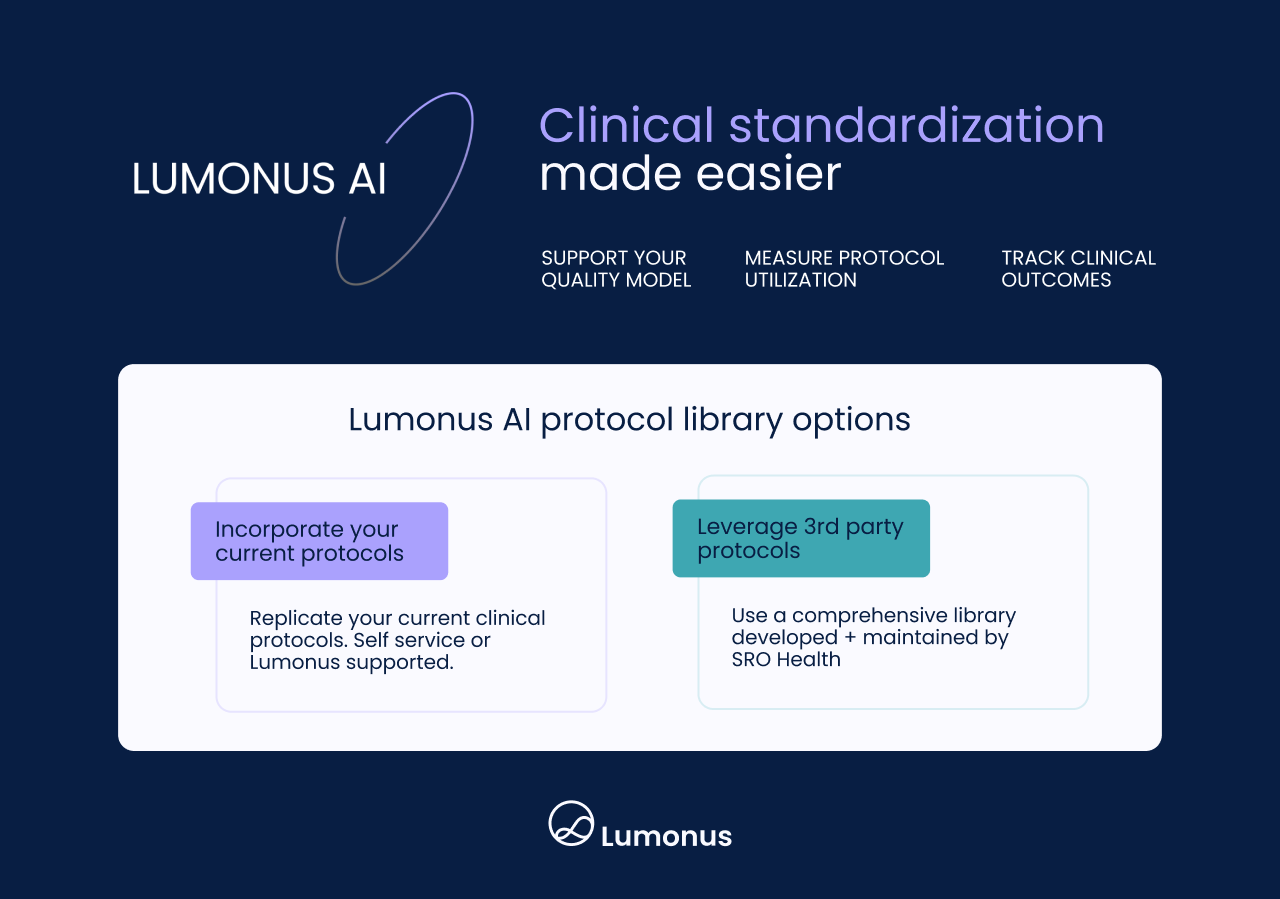
1. Incorporate your own protocols
For providers with established clinical protocol standardization programs, Lumonus digitizes and operationalizes these protocols directly within the Lumonus AI platform. We recognise that departments invest years building clinical expertise and institutional best practice and preserving that knowledge is essential.
Lumonus enables teams to faithfully replicate existing regimens, planning directives and institutional preferences, transforming static documents into structured, actionable AI-native workflows. Protocols can be configured through intuitive self-service tools or implemented with support from the Lumonus team, ensuring accuracy and alignment with current practice.
Recommended for: Providers looking to scale existing protocols while improving tracking and consistency.
2. Leverage proven third-party directives
Community-based cancer centres often lack the dedicated resources required to develop and maintain comprehensive clinical standardization programs. To address this, Lumonus AI enables providers to subscribe to third-party protocol libraries developed and actively governed by leading institutions, allowing teams to benefit from established clinical expertise without needing to build protocols from scratch.
For example, Lumonus has partnered with SRO Health, whose directive library originated at Northwell Health and has been refined over 16 years of real-world clinical use across 21 hospitals. These evidence-based directives provide consensus-approved pathways that are regularly reviewed and updated by subspecialist clinical reference groups.
This approach enables providers to rapidly implement high-quality, guideline-aligned care, reduce administrative burden and support consistent, peer-reviewed clinical practice with robust governance.
The benefits of clinical standardization at Northwell speak for themselves. Across more than 90,000 patients treated, these directives have been associated with:
- A decrease in denial rates from 10% to 1.5%
- 3–5 day reduction in authorization time
- 3× improvement in provider experience
Recommended for: Providers seeking accelerated standardization through a directive library actively governed by a leading radiation oncology network.

As one SRO Health customer and department leader shared:
“We have integrated the SRO Directives in our multi-physician radiation oncology department for the past 5 years and just renewed our license. Use of the SRO Directives has enhanced efficiency and expectations for patient care, improving outcomes and quality”
David M. Berlach, MD - Chair, Radiation Oncology, Maimonides Health, Brooklyn, New York
Standardization that works in the real world
Clinical standardization isn’t about rigidity. It’s about making it easier for care teams to deliver consistent, high-quality care while improving communication, confidence and patient outcomes.
When protocols are visible, maintained and embedded directly into clinical workflow:
- Physician administrative burden is reduced, with clear, structured guidance available at the point of care
- Dosimetry and Physics teams gain a clearer understanding of physician intent, reducing rework and improving planning efficiency
- Revenue cycle performance improves, supported by more complete, consistent and auditable clinical documentation
- Adoption of new techniques accelerates, as protocols can be updated, governed and deployed systematically
- Patient access improves, with reduced delays and more efficient care delivery
- Patients benefit from consistently applied, evidence-based treatment, aligned with the latest clinical standards
The future of evidence-based care depends not just on writing protocols, but on building systems that make them easy to implement, govern, measure and trust.
Learn more by contacting our team on our website or info@lumonus.com
References
1. Grol R, Grimshaw J. From best evidence to best practice: effective implementation of change in patients’ care. Lancet. 2003;362(9391):1225–30.
2. Ricci-Cabello et al. Adherence to breast cancer guidelines is associated with better survival outcomes:. BMC Health Serv Res. 2020;20(1):920.